
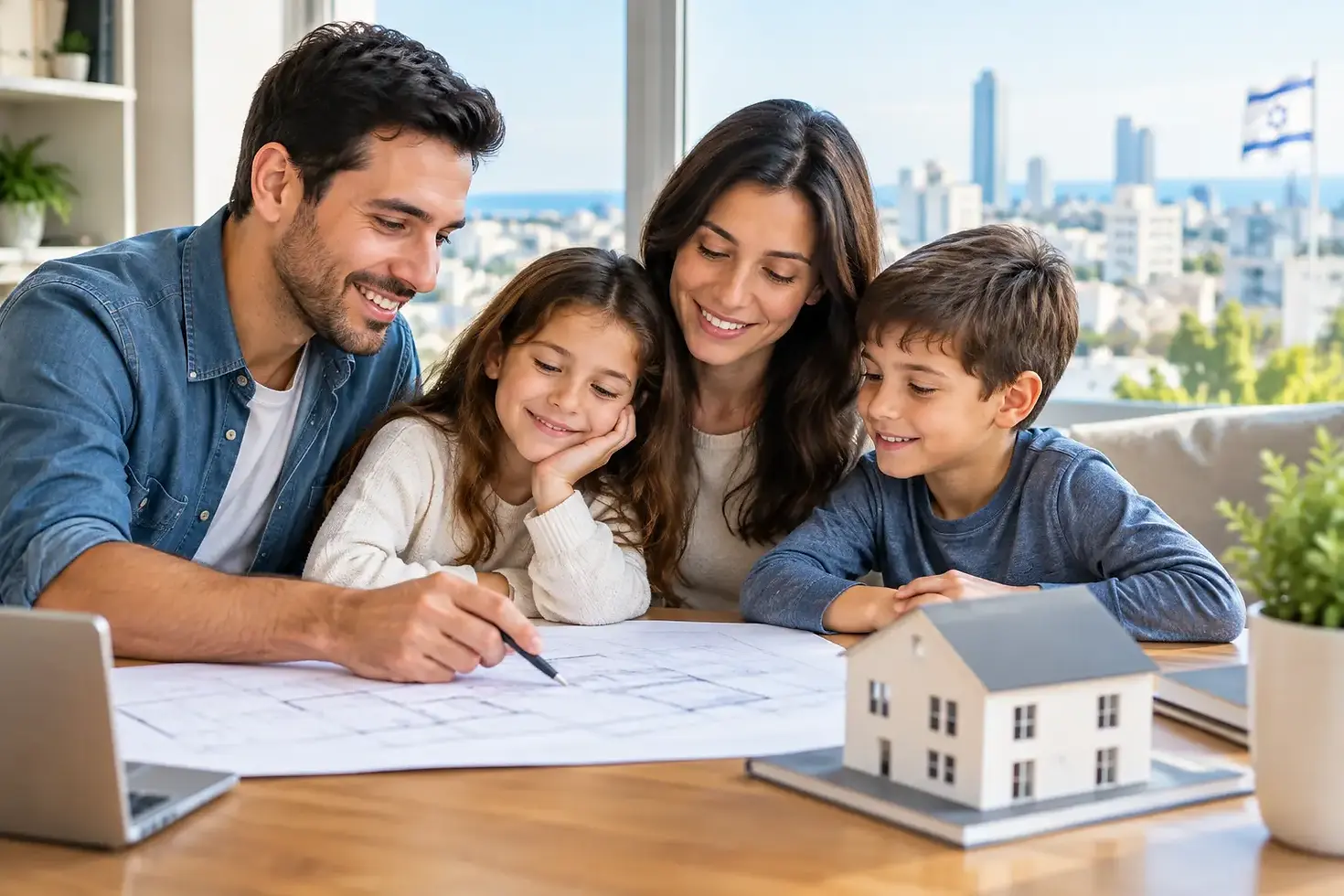
How Families Plan Israeli Homeownership Today

A finished apartment in Israel can require $1 million to $3 million upfront. For many American families, that number does not erase the dream of owning in Israel - it simply changes the plan. That is how families plan Israeli homeownership with greater intention: by separating the desire for a future home from the pressure to buy a finished property at today’s full market price.
For a family in New York, Florida, Los Angeles, or another center of Jewish life, Israeli property is rarely only a real estate decision. It can be a future landing pad for children, a retirement base, an Aliyah option, a place for holidays, or a tangible asset that keeps the family connected to Israel across generations. The strongest plans begin with that bigger purpose, then build an ownership strategy around it.
How Families Plan Israeli Homeownership Around Real Life
Families do not all need the same type of property, in the same city, on the same timetable. A couple nearing retirement may picture a home they can use regularly in eight years. Parents with young children may be thinking further ahead: a place their children can inherit, live near, or use as a base if life leads them to Israel. Other buyers want a long-term real estate position that can mature into a newly built residential apartment while preserving more of their capital today.
This is why the first conversation should not be, “Which apartment can we afford right now?” It should be, “What role should Israel play in our family’s next decade?” That answer informs location, timeline, budget, and property structure.
A family focused on future Aliyah may prioritize an area with established community life, transportation, schools, and everyday services. A buyer whose primary goal is a long-term investment may focus more closely on high-demand locations where planning and residential development are moving forward. A family seeking both emotional connection and financial strategy may look for a project that creates a future apartment while beginning with a more attainable entry point.
The goal is not to force every family into one model. It is to align the real estate decision with the life decision behind it.
Start With the End Goal, Not the Listing
Buying a completed apartment can feel like the most direct route to ownership. Yet it also concentrates the entire cost into one moment. For families comparing a $1 million-plus apartment purchase with a development-stage land position, the distinction is meaningful: one approach buys the present-day finished asset; the other is designed around the realization of a future residential asset over time.
Land realization gives qualified buyers a different way to enter the Israeli property market. The model centers on privately owned, Tabu-registered land in desirable locations that are in advanced stages of rezoning. As the planning and construction process progresses, the land position matures toward a newly built apartment, commonly over a five-to-ten-year horizon.
For families, that horizon can be an advantage because it mirrors how major life decisions actually unfold. Children grow up. Careers evolve. Retirement gets closer. A possible move to Israel becomes more concrete. Rather than treating homeownership as an all-or-nothing purchase, families can plan for the future they expect to inhabit.
That does not mean every buyer should choose the same timeline. Someone who needs immediate occupancy will naturally look at a different path than someone building a 2032 or 2035 plan. The point is that Israeli homeownership can be designed around the family calendar, rather than dictated solely by the current cost of finished apartments.
Build a Family Ownership Plan in Three Layers
A clear plan usually has three layers: purpose, capital, and stewardship.
Purpose: Define what the property is meant to do
A family should be able to describe the property’s role in one or two plain sentences. For example: “We want a future home in Israel for retirement and family visits.” Or, “We want to establish an Israeli asset for our children while keeping flexibility for a future move.”
This statement becomes the filter for every later choice. It keeps the conversation focused when comparing regions, project stages, and apartment profiles. It also turns a general wish to “own something in Israel” into a decision that can be evaluated strategically.
Capital: Choose an entry point that fits the larger plan
Many diaspora families have the financial capacity to invest in Israel but prefer not to place $1 million to $3 million into a completed apartment at once. A land-realization model can create an alternative entry point, with opportunities beginning around $175,000 depending on the project and ownership structure.
The difference is not merely about affordability. It is about capital allocation. Families may want to preserve liquidity for education, business interests, retirement planning, charitable commitments, or their US home while still taking a meaningful ownership position in Israel.
Planning also means involving the right people early. Spouses should share the same understanding of the timeline and purpose. Adult children can be part of the legacy conversation when appropriate. A family’s existing legal, tax, and financial advisors can help place the Israeli asset within the broader picture of family planning.
Stewardship: Establish trusted local representation
Distance should not require a family to feel disconnected from its property. US-based buyers need a credible, on-the-ground framework that coordinates the stages from acquisition through the realization of the residential asset.
This is where an advisory-led approach matters. A coordinated professional team can organize legal review, appraisal, engineering, planning coordination, and construction management within one structured process. Instead of trying to assemble separate relationships from thousands of miles away, families have a clear point of contact and a practical way to stay connected to progress.
HLK’s role is built around that stewardship model: helping buyers identify suitable land opportunities, understand the ownership path, and maintain professional support through the full realization process. For a family buying from the United States, that continuity is part of the value of the strategy.
Choose Location With Both Heart and Strategy
Israel is compact geographically, but location decisions carry real weight. A future home near family may matter more than a purely investment-driven selection. For another buyer, access to employment centers, rail connections, coastal demand, or emerging residential neighborhoods may shape the decision.
The best choice often sits at the intersection of personal affinity and long-term market logic. Families should ask where they already spend time in Israel, where they can envision a future routine, and which communities fit the lifestyle they want. They should also consider whether they are planning for a couple, adult children, grandchildren, or a broader extended family.
A two-bedroom future apartment may suit a retired couple who want a simple, comfortable base. A larger family may favor a different residential profile. There is no universal answer, but there should be a deliberate one. The property should serve the family’s likely life in Israel, not just a vague idea of owning there.
Make the Timeline Part of the Legacy Conversation
Long-term Israeli homeownership becomes especially powerful when families discuss it openly as a legacy asset. Unlike a short-term purchase made for immediate use, a development-stage position invites a broader conversation: What do we want to make possible for the next generation?
For some parents, the answer is optionality. They want their children to have an established connection and a future place in Israel, whether or not those children choose Aliyah. For others, the answer is permanence: a family asset that gives future generations a sovereign anchor in the country they care about.
This is also why a five-to-ten-year strategy can feel purposeful rather than distant. It creates time for the property plan and the family plan to develop together. The asset moves toward a future apartment while the family gains clarity about where, how, and when it may use that home.
A More Attainable Way to Think About Ownership
The traditional apartment market can make Israeli ownership seem reserved for buyers who can commit seven figures immediately. Families do not have to accept that framing as the only route forward. With the right project, a disciplined long-term horizon, and experienced local guidance, ownership can begin at a lower entry point and mature alongside the family’s goals.
The most meaningful Israeli home is not always the one available for move-in tomorrow. Sometimes it is the home a family begins planning now - with a clear purpose, a patient strategy, and a place already being made for the generations who will gather there.



Comments