
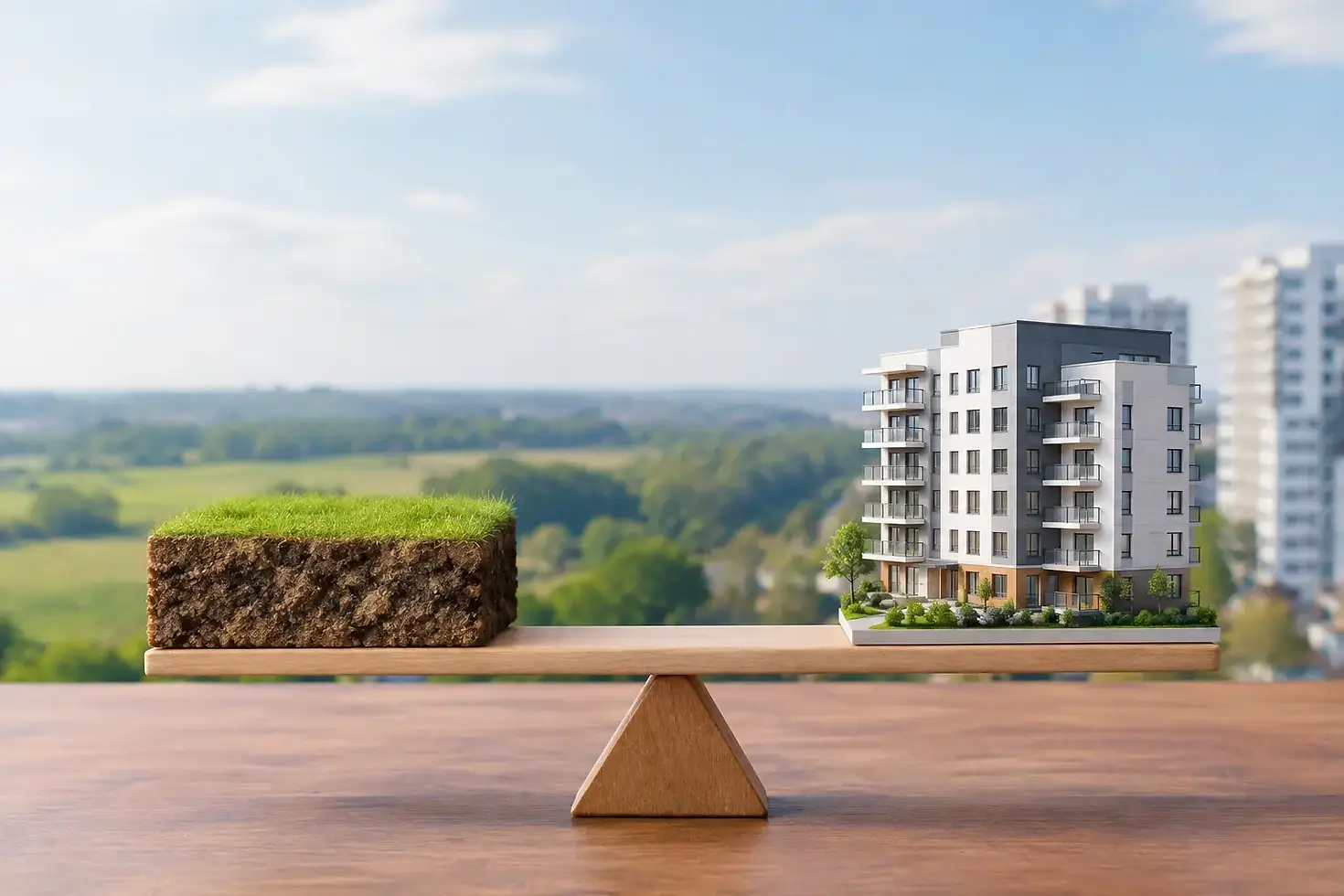
Land Appreciation Versus Apartment Appreciation

A finished apartment in Israel can offer immediate use, but it also asks buyers to enter at today’s fully realized price. For American families comparing land appreciation versus apartment appreciation, that distinction is often the starting point for a smarter conversation about timing, access, and long-term ownership.
In many sought-after Israeli locations, a completed apartment may require $1 million to $3 million or more. That puts ownership beyond reach for many people who want a future home in Israel, a retirement base, an Aliyah option, or a meaningful asset for the next generation. Development-stage land presents a different path: participate earlier in the real estate cycle, with a lower entry point and a defined realization horizon.
The choice is not simply between two property types. It is a choice between buying a finished lifestyle product now and positioning for the future value created as land becomes residential property.
Land Appreciation Versus Apartment Appreciation in Israel
Apartment appreciation and land appreciation are driven by related but distinct forces. Both benefit from demand for housing, desirable locations, population growth, and the enduring appeal of Israeli real estate. The difference lies in where each asset sits in the value-creation process.
A completed apartment has already passed through planning, construction, and delivery. Its value reflects a finished home that can be used immediately. Buyers are purchasing the completed product, including the location, the building, the unit itself, and the convenience of immediate occupancy.
Land in advanced stages of rezoning is earlier in that journey. Its value can grow as the property moves closer to an approved residential use and, ultimately, to a newly built apartment. This is often called land realization: acquiring an interest in strategically located land and following a structured process until that interest matures into a residential asset.
For a buyer with a five-to-10-year horizon, the attraction is straightforward. Rather than paying the full price of a finished apartment at the outset, they can establish a foothold in a high-demand Israeli location before the full residential value has been realized.
Why Finished Apartments Carry a Higher Starting Price
A finished apartment is simple to understand because the value is visible. You can walk through the lobby, see the view, measure the bedrooms, and picture family holidays around the dining table. For buyers who need an immediate residence or want to rent a completed unit right away, that clarity has real value.
It also explains the price. The market has already recognized the apartment as a usable, finished home. A purchaser is buying after the major stages of value creation have occurred. In prime Israeli markets, that can mean committing a substantial amount of capital from day one.
For some families, that is the right decision. A couple planning an imminent move to Israel may prioritize a home they can occupy now. Parents who need a ready apartment for a child beginning university may also favor immediate availability.
But not every buyer needs keys this year. Many Americans are planning further ahead: retirement in Israel, a future landing pad for children, a family gathering place, or a long-term investment tied to a personal connection with the country. For these buyers, paying the premium for immediate use may not be the only way to build ownership.
How Land Creates a Different Appreciation Story
Land appreciation is tied to the transformation of a parcel from its current planning status into a residential outcome. In the strongest land-realization opportunities, the location matters first. Privately owned, Tabu-registered land in areas with significant housing demand can become especially compelling when it is already progressing through advanced rezoning stages.
The opportunity is not based on buying land somewhere remote and hoping a city eventually arrives. It is based on identifying land near the path of growth, where residential demand, planning momentum, and location align. As the land advances toward its intended residential purpose, the economic character of the asset changes as well.
This is why land and apartments should not be judged only by a single present-day price per square foot. A finished apartment represents completed value. Development-stage land represents participation in the creation of that value over time.
That distinction can be particularly meaningful in Israel, where demand for well-located residential housing is shaped by family formation, immigration, limited land availability, and the desire to live near employment centers, schools, communities, and transportation.
A Lower Entry Point Can Change the Ownership Equation
For many US buyers, the biggest practical difference between the two paths is the initial capital requirement. Instead of allocating $1 million or more to a completed apartment, a land-realization strategy can begin from approximately $175,000, depending on the project and the buyer’s goals.
That lower entry point does more than make ownership feel possible. It can allow a family to enter the Israeli market while preserving flexibility for other priorities, whether that is a US residence, retirement planning, education, business ownership, or supporting children.
It can also make strategic matching more important. A buyer seeking a future home in a specific region has different needs from an investor focused on long-term appreciation. A family in New York or Florida may want a future base near relatives and community. A pre-retiree in California may be planning a gradual transition toward more time in Israel. The right project begins with the intended role the future apartment will play in that person’s life.
Comparing the Two Paths by Time Horizon
The most useful comparison is not which asset is universally better. It is which path fits your timeframe.
A completed apartment serves the buyer who values immediate use. It offers a tangible home from the beginning and fits a near-term relocation, family need, or rental objective. Its appreciation is generally connected to the ongoing market value of a finished apartment in that neighborhood.
Development-stage land serves the buyer who is comfortable planning ahead. The expected timeline is typically five to 10 years, giving the asset time to move through its realization path toward a newly built residential apartment. Its appreciation story is connected to advancement from land status toward residential completion, alongside the underlying strength of the location.
For a family building a 10-year plan, that time horizon can be an advantage rather than an inconvenience. The future apartment does not need to solve today’s housing need. It can be designed around the life stage that is coming next: retirement, Aliyah, children settling in Israel, or a legacy asset that keeps the family connected across generations.
The Value of Guided Land Realization
Buying property in another country should feel organized, not distant. For US-based buyers, the appeal of a guided land-realization model is not limited to access to land. It is the presence of an experienced local team that can coordinate the journey from acquisition through realization.
That process includes project selection, legal and appraisal coordination, engineering and planning oversight, and ongoing management toward the residential outcome. Buyers remain connected to the process without needing to become experts in every local professional discipline.
HLK approaches this as an advisory relationship, not a one-time transaction. The goal is to understand whether a buyer is seeking investment growth, a future home, a retirement base, or a family asset, then match that goal to an appropriate opportunity. That kind of alignment matters because real estate is personal. A future apartment in Israel can be an investment, but it can also be a sovereign anchor for a family’s next chapter.
Appreciation Is Also About What Ownership Makes Possible
Financial appreciation matters, especially when Israel’s completed apartment market can feel out of reach. Yet for many diaspora families, the value of a future Israeli apartment extends beyond a spreadsheet.
It can mean knowing there is a place to return to for holidays and family milestones. It can mean giving children a connection that is more concrete than an annual visit. It can mean preparing for a future move without forcing every decision into the present. And it can mean holding an asset in a country that carries deep personal, cultural, and familial significance.
That is why the land-realization model resonates with buyers who think in decades rather than quarters. They are not simply choosing between a plot of land and a finished unit. They are choosing how and when to establish a meaningful place in Israel.
The best starting point is a clear personal question: do you need an apartment now, or are you building toward the apartment your family will need next? The answer can turn Israeli real estate from an intimidating purchase into a deliberate, well-positioned plan.


Comments